G. K. Chesterton
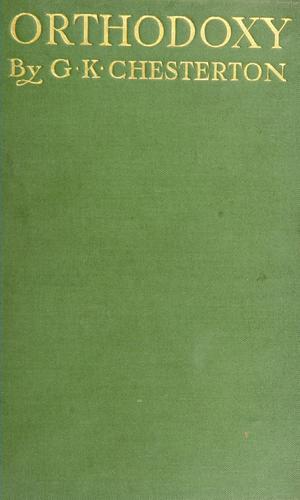
Free Orthodoxy by G. K. Chesterton — PDF EPUB Download
Free Orthodoxy Chesterton PDF: The Most Joyful Defence of Faith
If you are searching for a free Orthodoxy Chesterton pdf, you have found G. K. Chesterton at his brilliant best. Published in 1908, Orthodoxy is his joyful defence of the Christian faith, written as the story of how he came to believe, through fairy tales, common sense, and the strangeness of the world. Witty, paradoxical, and full of wonder, it argues that orthodoxy is not a prison but the most thrilling adventure of all. It remains Chesterton's most beloved book, read by believers and unbelievers alike. It is in the public domain in the United States, so you can download it legally and free in PDF and EPUB on Noveliopdf, with no account and no payment.
Chesterton called the book an attempt to answer the challenge that a friend had set him: to explain why he believed what he believed. Instead of writing a theological treatise, he wrote a kind of spiritual autobiography, describing the ideas he had picked up as a young man, wandering through the philosophies of his day, and showing how each one led him, to his surprise, toward the old Christian faith. The book's famous image is that of a man who sets out to discover a new continent and finds England, or who sails the world to found a new city and discovers that he has arrived home. Chesterton's point is that the ancient faith, examined with fresh eyes, turns out to be the most exciting and reasonable thing in the world.
What Orthodoxy Is About
The chapters of Orthodoxy each take on a different idea and turn it upside down. The Maniac defends the sanity of orthodoxy against the fashionable madness of his age, arguing that the madman is not the one who has lost his reason but the one who has lost everything except his reason. The Suicide of Thought attacks the idea that all beliefs are equally true, showing that such relativism destroys itself. The Ethics of Elfland is the book's most famous chapter, in which Chesterton argues that fairy tales taught him more about reality than philosophy did: that the world is strange, that gratitude is the proper response to existence, and that the rules of things are like the rules of a game, arbitrary and yet full of meaning.
Later chapters defend the doctrines that modern readers find hardest: original sin, the paradox of the crucifixion, the authority of tradition, and the romance of orthodoxy itself. Chesterton argues that Christianity is the only philosophy that takes both the goodness and the badness of human beings seriously, and that its paradoxes, God as both infant and king, the world as both a tragedy and a comedy, are the marks of truth rather than of confusion. He writes throughout with a lightness that makes heavy subjects feel like a conversation in a pub, full of jokes, images, and sudden flashes of poetry. Readers who know Chesterton only from his Father Brown stories in The Innocence of Father Brown will be delighted to find the same wit turned to philosophy.
About G. K. Chesterton
Gilbert Keith Chesterton (1874-1936) was an English writer, journalist, and critic, one of the most prolific and versatile authors of his age. Born in London, he studied art before turning to journalism, and he wrote on everything from politics to detective fiction, producing some hundred books, thousands of essays, and a weekly newspaper column. His Father Brown stories created one of the great detectives of literature, a humble priest who solves crimes by understanding the human heart, and his novel The Man Who Was Thursday is a metaphysical thriller unlike anything else in English fiction.
Chesterton began as an Anglican and converted to Roman Catholicism in 1922, fourteen years after Orthodoxy was published. The book already contains the whole direction of his thought, and it is often read as the prelude to his conversion. His other works of the period include The Napoleon of Notting Hill, a comic fantasy about London, and The Club of Queer Trades, a collection of ingenious stories. Chesterton's influence extended far beyond his own time: C. S. Lewis credited Orthodoxy with helping to bring him to faith, and writers from Borges to Neil Gaiman have admired his imagination. Because he died in 1936, his work is in the public domain in the United States, so a free Orthodoxy Chesterton pdf is entirely legal to download and share.
The History of Orthodoxy
Orthodoxy was first published in London in 1908, and it was an immediate success, going through many editions in Chesterton's lifetime. It appeared at a moment when the old certainties of Victorian England were dissolving, and readers on both sides of the religious divide found in it a fresh and vigorous voice. The book was written partly in response to his earlier Heretics of 1905, in which Chesterton had attacked the leading thinkers of his day, and readers demanded to know what he believed himself. Orthodoxy was his answer.
The book's reputation has only grown since. It was praised by George Bernard Shaw, who disagreed with almost everything in it but admired its brilliance, and by the young C. S. Lewis, who read it as a student and later wrote that it baptised his imagination. In the twentieth century it became a classic of Christian apologetics, ranked alongside the works of Lewis and Pascal, and it continues to be recommended to seekers, students, and readers who want to understand why intelligent people believe. Modern editions often pair it with Heretics, so readers can enjoy both the attack and the defence.
Why Readers Still Read Orthodoxy
Readers keep coming back to Orthodoxy because it is unlike any other book about faith. It is funny, first of all, and Chesterton's jokes and paradoxes make it a pleasure to read even for people who disagree with every word. It is also deeply imaginative: his argument from fairy tales, his image of the world as a place where a tree might be a prince in disguise, and his defence of wonder as the proper attitude to life have influenced writers far outside the Christian tradition. And it is honest: Chesterton admits what he does not know, praises his opponents when they are right, and never pretends that faith is easy.
The book is an excellent starting point for anyone curious about Chesterton, and for anyone who wants to understand the Christian imagination at its most joyful. If you enjoy it, read The Man Who Was Thursday for his fiction at its most inventive, The Innocence of Father Brown for his detective stories, and The Napoleon of Notting Hill for his comic fantasy of London.
How to Download Orthodoxy Free (PDF and EPUB)
You can download Orthodoxy free in PDF and EPUB on Noveliopdf. The PDF is ideal for reading on a computer or tablet and for printing, while the EPUB works on phones, e-readers, and apps, and can be sent to a Kindle. To get your free Orthodoxy Chesterton pdf, open the book page, choose PDF or EPUB, and the file downloads directly while the website stays open, with no sign-up and no payment. The text comes from Project Gutenberg, the trusted public-domain library, so the edition is complete and legal.
If you arrived here by searching for an Orthodoxy free pdf download, you are in the right place: this Orthodoxy by G. K. Chesterton free edition gives you the complete book in both formats, and the Orthodoxy free epub works on phones, tablets, and e-readers, while an Orthodoxy Chesterton pdf is the best choice for printing or reading on a larger screen.





