Henryk Sienkiewicz
Free With Fire and Sword by Henryk Sienkiewicz — PDF EPUB Download
Free With Fire and Sword PDF: Sienkiewicz's Sweeping Historical Epic
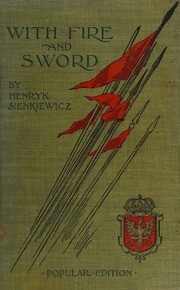
If you are looking for a free With Fire and Sword pdf, you have found one of the great historical novels ever written. Published in 1884, With Fire and Sword is the first volume of Henryk Sienkiewicz's famous Trilogy, a vast epic of war, love, and loyalty set in seventeenth-century Poland. Sienkiewicz, who would go on to win the Nobel Prize in Literature in 1905, wrote the novel for a nation that had been partitioned and erased from the map of Europe, and his story of Poland fighting for its life became a source of national pride for generations of readers. The novel is in the public domain in the United States, which means you can download it legally and free in PDF and EPUB on Noveliopdf, with no account, no payment, and no trial to cancel. Whether you love historical fiction, epic adventure, or the author of Quo Vadis, this free With Fire and Sword pdf is a magnificent place to start.
The novel opens in the year 1648, on the wild steppe of Ukraine, where the Polish-Lithuanian Commonwealth is about to face the greatest crisis in its history. Bohdan Khmelnytsky, a Cossack leader, has raised a rebellion against Polish rule, and his armies — Cossacks and Tartars together — are sweeping across the land. Into this storm rides Jan Skrzetuski, a young lieutenant of the Polish hussars, a brave and honourable soldier who has just fallen in love with Helena Kurcewiczówna, a beautiful young noblewoman living on a lonely estate. Their love is barely begun when it is shattered: Helena is seized by Bohun, a fierce Cossack colonel who wants her for himself, and Skrzetuski must fight his way through a country at war to find her. Around them, Sienkiewicz gathers one of the great casts of historical fiction: Zagłoba, a fat, drunken, endlessly inventive nobleman whose cunning saves his friends again and again; Longinus Podbipięta, a gentle Lithuanian giant who wields an enormous sword; and Michał Wołodyjowski, a small, quiet swordsman who is the deadliest fighter in the Commonwealth.
What With Fire and Sword Is About
The love story is the thread that runs through the novel, but the book itself is about something larger: a nation fighting for its survival. Sienkiewicz follows the war through its great battles — the Polish defeats at Yellow Waters and Korsun, where the Commonwealth's armies were destroyed; the desperate defence of Zbarazh, where a small garrison held out against a vast besieging army; and the final, terrible battle of Berestechko in 1651, one of the largest battles in European history. The battle scenes are among the finest ever written: Sienkiewicz had a gift for making the chaos of war vivid and comprehensible at once, for showing the clash of hussars and Cossacks, the thunder of cannon, and the courage of men who know they are outnumbered and fight anyway. But he never lets the battles become mere spectacle. Every charge, every siege, and every retreat is tied to the fate of people the reader cares about, and the war matters because Helena, Skrzetuski, and their friends are caught in it.
The novel is also, famously, a work of national myth-making. Sienkiewicz was writing for Polish readers living under Russian, Prussian, and Austrian rule, and his portrait of seventeenth-century Poland — brave, honourable, devout, and united in the face of disaster — was meant to remind them of who they were. Modern readers and historians have noted that his picture of the Cossacks and Tartars is one-sided, and that the real Khmelnytsky uprising was a more complicated affair than the novel allows. That is a fair criticism, and it is worth knowing. But it does not diminish the novel's power as a story: as an adventure, as a romance, and as a portrait of people tested by war, it remains one of the great achievements of the historical novel.
The Trilogy and the Khmelnytsky Uprising
With Fire and Sword is the first of three novels that Sienkiewicz called his Trilogy, and it is best read as the beginning of a larger story. The second volume, The Deluge, published in 1886, follows the Swedish invasion of Poland in the 1650s and the defence of the monastery of Jasna Góra; the third, Fire in the Steppe, published in 1888, follows Wołodyjowski's later career on the Turkish frontier. Characters cross from one volume to the next, and the friendship between Skrzetuski, Zagłoba, Podbipięta, and Wołodyjowski — the four companions whose loyalty holds through every disaster — is the emotional centre of all three books. Zagłoba, in particular, has become one of the most beloved comic characters in Polish literature: a coward who talks like a hero, a drunkard who schemes like a general, and a man whose loyalty to his friends is the one thing about him that is never a joke.
The historical background is worth understanding before you begin. In the seventeenth century, the Polish-Lithuanian Commonwealth was one of the largest states in Europe, stretching from the Baltic to the Black Sea, and Ukraine — then called the Borderlands — was its wild eastern frontier, a land of Cossack horsemen, Tartar raiders, and Polish landowners. The Khmelnytsky Uprising of 1648 began as a Cossack revolt against Polish rule and became a war that devastated the country and changed the map of Eastern Europe. Sienkiewicz, writing more than two centuries later, turned that war into an epic, and his novel has shaped how generations of readers imagine the period — much as Walter Scott's novels shaped how readers imagine Scotland, or Victor Hugo's shaped how they imagine France.
Jan Skrzetuski, Helena, and Bohun
At the heart of the novel is a love triangle drawn in the boldest colours. Jan Skrzetuski is the ideal hero: brave, loyal, and honourable, a man whose word is his bond. Helena Kurcewiczówna is the ideal heroine: beautiful, devout, and brave in her own quiet way, enduring captivity and danger without losing her faith or her love. And Bohun, the Cossack colonel who carries her off, is the ideal villain — or so he seems at first. Sienkiewicz gives Bohun a passion and a grandeur that make him more than a simple villain: he loves Helena truly, if terribly, and his rage at losing her is the rage of a man who has never been refused anything. The struggle between Skrzetuski and Bohun for Helena is the novel's driving force, and it is resolved only in the final pages, after battles, sieges, escapes, and a journey across a burning country.
The novel's greatness, though, lies less in its heroes than in its company. The four friends — Skrzetuski, Zagłoba, Podbipięta, and Wołodyjowski — are the book's soul, and their friendship, tested in every chapter by war, hunger, and danger, is what readers remember longest. Zagłoba's tall tales, Podbipięta's gentle strength, Wołodyjowski's quiet deadliness, and Skrzetuski's steadfast honour make a quartet that has been compared, not unfairly, to the Three Musketeers. If you enjoy this novel, Quo Vadis, Sienkiewicz's most famous book, is the natural next read, and The Three Musketeers, Ivanhoe, and The Prisoner of Zenda are the great swashbuckling adventures in the same tradition — all free on Noveliopdf.
How to Download With Fire and Sword Free
Downloading your free With Fire and Sword pdf is simple. Go to the book page for With Fire and Sword, choose the PDF or EPUB button, and the file downloads straight to your device while the website stays open, so you can keep browsing for your next read. The PDF is ideal for reading on a computer or tablet and for printing, while the EPUB works beautifully on phones, e-readers, and reading apps, with adjustable text size and bookmarks. Both files are the complete, unabridged novel, in the public domain in the United States, so the download is completely legal and completely free. There is no account to create and nothing to pay. Whether you are reading Sienkiewicz for the first time or returning to an old favourite, one of the great historical epics is waiting for you, free, on Noveliopdf.